By RAHN ADAMS
BOONE, N.C. (Feb. 18, 2026) – All week I’ve been intending to write this essay about the recently concluded Walk for Peace — the part of it where, not the rubber, but the bare feet of Buddhist monks and their Peace Dog met the road on their trek across the Bible Belt. That part of the mission officially ended last Wednesday.
According to the monks’ leader, the Venerable Bhikkhu Pannakara of Fort Worth, Texas, an individual’s walk for peace by practicing mindfulness should never end. That person should seek this type of peace for the rest of his or her life. And if they keep trying to find that peace within themselves — that “inner child,” he called it — they will not have failed.
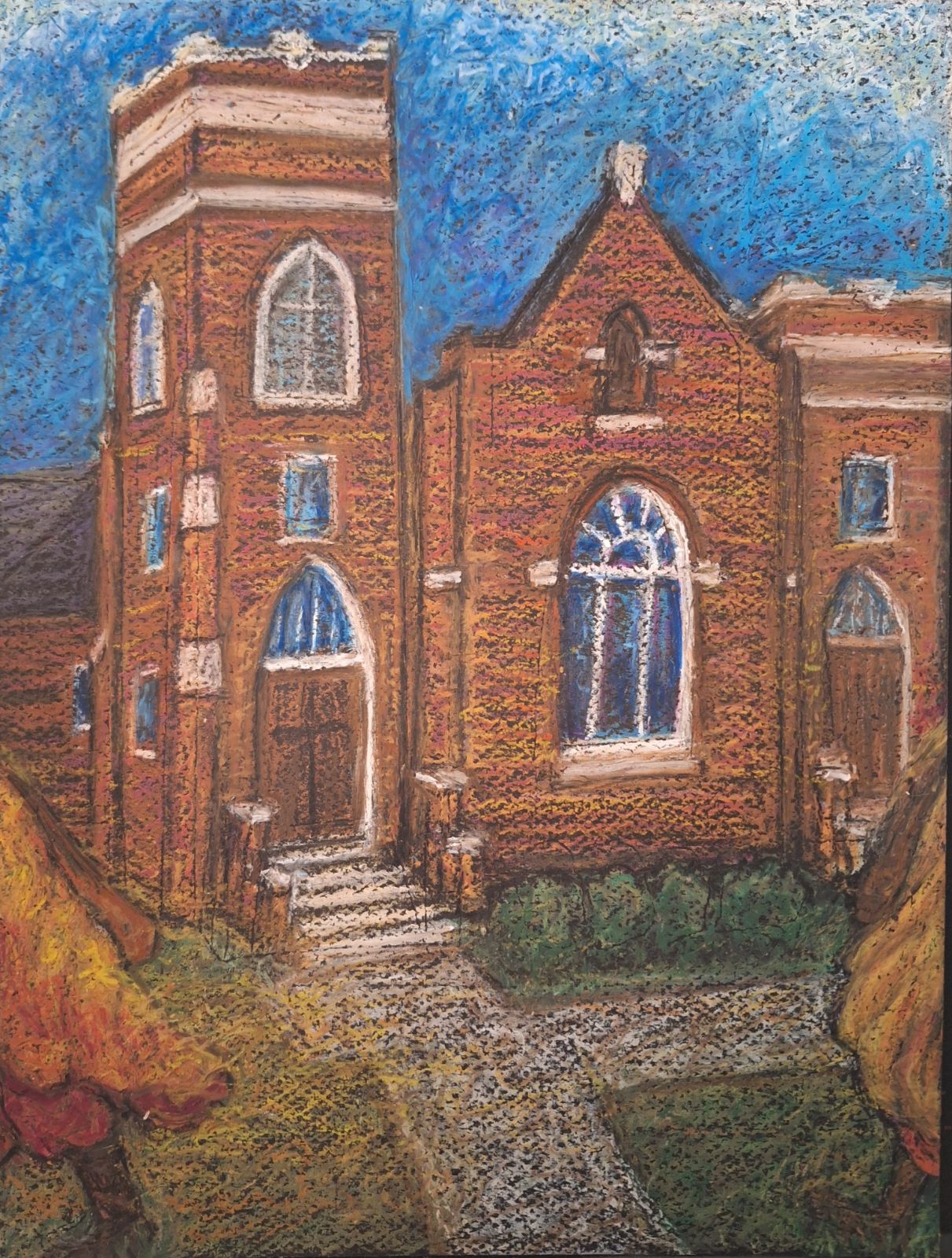
That was my own epiphany — the monks’ definition of peace — after seeing them in person with Timberley on Jan. 16 outside Mount Olivet United Methodist Church near Kannapolis, N.C. The historic church, with its own old cemetery, is located across the street from Carolina Memorial Park, which covers the entire hillside there.
According to the Find-a-Grave website, more than 28,000 individuals rest in peace on that sacred hill where we met the monks.
It was the 83rd day of their mission that had begun on Oct. 26, 2025. Distance-wise, they were almost midway through the 2,300-mile, 108-day walk from Bhikkhu Pannakara’s home temple in Fort Worth to the National Cathedral in Washington, D.C. They officially ended the sacred walk with a peace rally at the Lincoln Memorial last Wednesday on Day 109. On Days 110-112, they visited Annapolis, Md., and returned to Fort Worth by bus.
As Bhikkhu Pannakara taught almost every day along the way — giving hour-long teaching talks at the monks’ lunch stop and again wherever they spent the night — they weren’t walking for world peace, as such. It was obvious that these dark-skinned men in saffron robes weren’t like the peace protesters of the 1960s and ’70s across the United States, or like the civil rights activists of the 1950s and ’60s in the American South. Also, they weren’t like the Beatles on tour in America in 1964 shortly after President Kennedy’s assassination, or like John and Yoko doing their antiwar Bed Peace thing in 1969.
The monks did, though, attract hundreds and often thousands of admirers along their route and at their stops. But there was no screaming — well, except for the “megaphone guy,” a born-again zealot who followed them for an estimated 60 days, according to Facebook, including their passage through North Carolina.
Step by step, the venerable monks showed us — demonstrating in the most basic way — how each of us can find peace of mind in our own private worlds that may have started spiraling out of control for any number of reasons. Only then is peace on earth and goodwill toward other people possible, the lead monk taught.
I had intended to write about Bhikkhu Pannakara’s simple teachings and to emphasize, as he did over and over, how advocating mindfulness — a focus on one’s breath to calm oneself — is neither religious indoctrination nor political persuasion. But you’d be better off watching his talks for yourself. They’re posted on both Facebook and YouTube. You could pick any talk along the way and hear the same basic lesson. It’s simple to comprehend, easy to do once, but difficult to continue doing on a daily basis.
In this essay, I also wanted to consider why so many people along the monks’ route greeted them with the simple expression, “Thank you.” Those are the words you’ll hear most often from people gathered on the roadsides to watch the monks’ procession if you go back and view the livestreams. The bystanders represented all races and social backgrounds, it appeared, apparently there to witness a simple and selfless act to promote peace and bring hope to our shared world of increasing hatred and despair.
Maybe the tougher question is, why aren’t we all thanking our own religious or political leaders now for promoting peace and giving us hope for our futures? More precisely, why aren’t we going out of our way to stand along some cold highway to thank, say, the Rev. Franklin Graham or Sen. Mitch McConnell for giving us Donald J. Trump? You know the reasons why, so I won’t repeat them.
Frankly, I don’t have the time or patience to list all of the ways that Donald Trump has debased everyone and everything he has touched since long before he sought to become the most powerful individual on earth. He has always been evil. Now he is demented, too.
Trump is often compared to corrupt president Richard Nixon, the only chief executive so far to resign our nation’s highest office, and to Sen. Joseph McCarthy (R-Wis.), whose Communist witch hunts in the 1950s roiled American society and robbed citizens of their inalienable rights, just as Trump and his MAGA minions are doing now. In case you didn’t already know, Trump has direct connections to both of those failed political leaders.
But back to the Walk for Peace… At a meeting of several hundred interfaith leaders inside the Washington National Cathedral on Feb. 10, Bhikkhu Pannakara fielded a question asking for his opinion of Christian Nationalism and for any advice he might give to Christians. His nearly three-minute answer was that he respects all religions and that “I don’t have that knowledge” to talk about them. I’m sure he knows that Christian Nationalism is not a religion; it is a political system. But the Walk for Peace wasn’t about politics, either, so he did right to tread softly. (Click here to hear the question and the monk’s answer, from 1:08:15 to 1:10:52.)
Speaking of questions, it occurred to me this morning at 3 a.m. that we want the wrong person to answer publicly the famous question that turned the tide in the televised Army-McCarthy hearings in June 1954, when U.S. Army attorney Joseph Welch asked Sen. McCarthy on live television: “Do you have no sense of decency, sir, at long last? Have you left no sense of decency?” If Donald Trump were asked that question, he would just laugh and continue lying and bullyragging everyone.
No, we need to ask that question of the Franklin Grahams, the Mitch McConnells and Lindsey Grahams; our white evangelical, fundamentalist Christian preachers and our Republican legislators; and any other public figures who have defended Donald Trump, supported MAGA and its Christian Nationalism, and attacked our democratic institutions at Trump’s behest. We need to call those people out and show them for what they are — hypocrites and self-serving enablers, at best.
Like the Buddhist monks of the Walk for Peace, Jesus of Nazareth was a peaceful man, but even he became violent when he found the temple being turned into a “den of robbers” by greedy money-changers and merchants. There’s both a time and a place to speak up and stand up — to show that we Americans do have a sense of decency, at long last, and to demand that our religious and political leaders prove they will behave decently as well.
Today is Ash Wednesday, the day when many Christians are told to “remember that [they are] dust and to dust [they will] return.” Then a priest or minister uses ashes from burned palm fronds to mark congregants’ foreheads with black X’s. The people leave silently so that they can think about the impermanence of life.
I used to do that, too, but now I remind myself, “Today is going to be my peaceful day.” On a few days I do succeed; most days I fail before lunch. But I keep trying.
Ash Wednesday is the first day of Lent, the 40-day period (not counting Sundays) of fasting and reflection leading up to Easter, the most hopeful Christian holiday of all. Wouldn’t it be nice if white evangelical or fundamentalist Christians could use Lent to reflect on their devotion to a man who is the very antithesis of Christ?
Rise and resist, peaceably if possible, while you still can. With words, courage and determination. Before it’s too late.