By RAHN ADAMS
BOONE, N.C. (Feb. 4, 2026) – Yesterday when we left our house to drive into town, we saw three beautiful girls playing in the snow at a neighbor’s house. They seemed to be in much better moods than the last time we saw them outside.
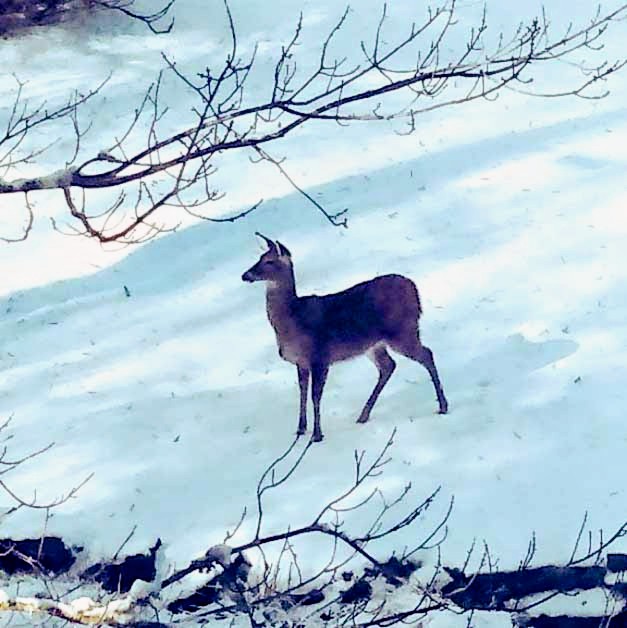
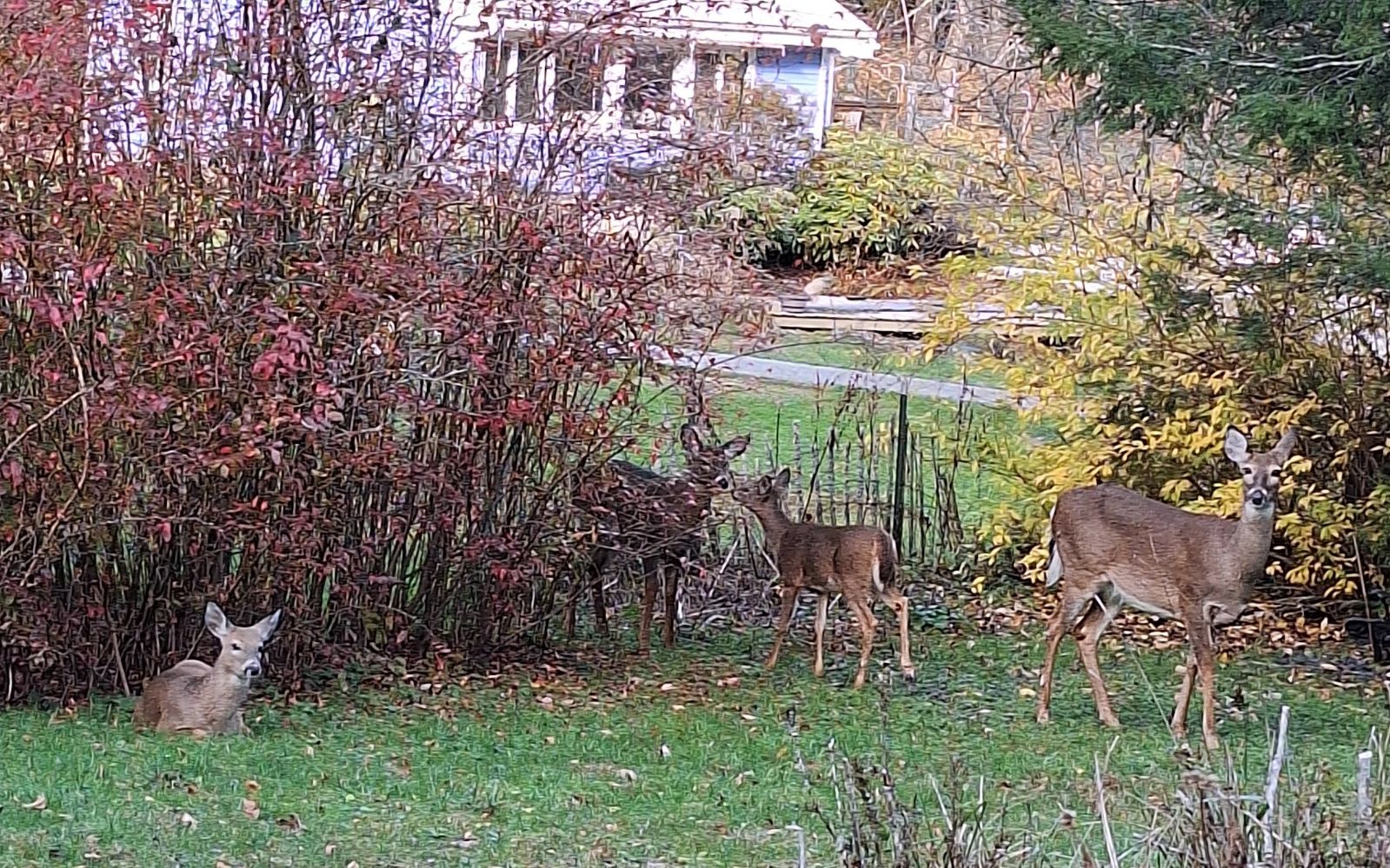
That occasion was a few days before Christmas, and, once again, we were in the car but headed in, not out. The girls caught our attention that time because they were frantically running toward us as we parked in our driveway. “Hey!” I said. “What’s going on? What’s wrong?”
Startled to see us, the three large does — that is, female deer — veered away and cut through the yard, then around the house into the woods. As we climbed the stairs to our front deck, Timberley spotted what was wrong. “Look,” she said. “Over there. It’s hurt.”
It was a good-sized buck, a young spike that was half lying, half sitting in a ditch across the hollow from our house. One hindquarter was injured, keeping it — or I should say him — from even standing, much less running. But he could hold his head up, and he was alert.
I crossed our yard, hopped across the little creek that divides our property from our neighbor’s, and crept as close to the buck as I could without alarming it. The cause of his injury wasn’t evident. I saw no gunshot wounds and no blood showing on him.
He must have gotten hit, I thought, wincing myself as the deer jerked his head toward me and then started to thrash on the ground in an attempt to pull himself up out of the ditch to run away. Unable to rise, the buck struggled for a time, then just crumpled and didn’t move.
More than likely, the deer had been struck by a vehicle on U.S. 421 about a half mile over the wooded ridge from our hollow, maybe less as the crow flies. The poor boy must have dragged himself up the hill and through the trees before collapsing next to our neighbor’s driveway.
When I got back to the house, I told Timberley what I’d seen happen. In a way, I was glad it had worked out like that. But she looked out the picture window and corrected me. “He isn’t dead,” she said. “He’s moving his head. And he just sat up again.”
I looked, and, sure enough, the buck was back in the same position we had initially found him. Now, I knew what needed to be done, but I’ve never been a hunter, not even of squirrels or rabbits. The extent of my killing has been mice — and that was before I discovered live-catch mouse traps.
So, yeah, I’m a weenie when it comes to killing warm-blooded animals. Besides, the only firearm I had access to that afternoon was a .22-caliber pistol, a pea shooter basically, not exactly what ol’ D Boon used to kilt a bar or a deer in them thar hills. Not to mention, in the 40-odd years I’ve owned that little gun, I’ve shot it maybe three times and destroyed nothing but aluminum cans. I’m not exactly sure why I bought it in the first place. Snakes, I guess.
At the same time, I know of some people who think little or nothing about killing perfectly healthy animals, even pets, whether for sport or for convenience. I could tell you horror stories of family dogs, good dogs, being killed because that was quicker and easier (for the killer) than dealing with some minor problem that had arisen involving the animal.
As far as deer hunting — or any kind of hunting, big game or small — goes, I always think of the opening scene of The Last of the Mohicans, in which buckskin-clad Hawkeye, Uncas and Chingachgook slay an antlered deer, an elk, I believe, and then kneel by the once-majestic creature to offer a prayer of thanksgiving to the Great Spirit for the animal’s sacrifice. They need the big buck — their brother, they call him — for his flesh, hide, sinew and bone, not as a trophy to mount and hang on a wall.
What ended up happening with our injured deer? Well, as you can imagine, at least two neighbors had also seen the buck lying hurt in the ditch. One had already called the state wildlife commission’s local office to send someone to handle the matter. When an officer hadn’t arrived after a time, the other neighbor — who was a hunter and owned a deer rifle — reluctantly agreed to dispatch the suffering animal.
Just as he left his house with rifle in hand, a wildlife vehicle pulled into our hollow. The officer parked the truck 20 yards from the deer. From our front porch, we watched him approach the buck cautiously and assess the situation quickly. He carried a sidearm on his belt, but he motioned to our neighbor, nodded toward the injured animal and said something I couldn’t hear.
Timberley, who hears everything, translated for me: “He said, ‘Go ahead, if you don’t mind. That’s what I have to do, anyway.'” I could see both men’s faces, though, and neither one appeared to take pleasure in what was about to happen. There were no smiles, no joking around. This was serious.
Our neighbor nodded and positioned himself about 10 yards in front of the buck. Our friend — like me, a retiree, but in better shape — went down onto one knee, sighted through the rifle’s scope for a long second, and fired one shot.
There was no celebration. The two men — one a hunter, the other a wildlife officer — checked the deer’s body and found no other gunshot wounds. They, too, speculated that the buck might have been hit on the highway, or that the spike had been injured in a fight with a larger, stronger buck. It was late in mating season, but we had seen those three does run through our yard before we found the buck in the ditch.
Within minutes, the officer had loaded the deer into the back of his vehicle and was gone. Our neighbor, the hunter, talked quietly for a minute with the neighbor who had called the wildlife office, and then they both returned to their homes. We, too, went back inside our house and got back to whatever activity we had planned to do before seeing the injured deer.
Yeah, I’m a weenie when it comes to killing things. I don’t know why that is. But I’m not ashamed to admit it. I don’t think I could have killed that buck even if I’d had a high-powered weapon that could have done what was necessary as cleanly and quickly as that deer rifle did. That’s why I catch and release mice, as silly as that sounds (and may be).
One last point, or maybe this is my only real point: Throughout the rough draft of this column, I referred to the injured buck with the more standard pronoun “it” for references to an animal. But when I read over the piece early this morning, something didn’t feel quite right. I wasn’t showing the proper respect for the animal’s life and death. Maybe you noticed that this final draft uses masculine pronouns for him, just as I had used, without thinking, feminine pronouns and identifiers (like “girls”) for the three does.
What’s my point? It’s that, yes, pronouns do make a difference. Maybe not for you, the reader. But they do for me, the writer, the storyteller, because they reveal my attitude, what I actually think about that being or that thing I’m writing about. The pronoun I choose suggests to the careful reader (or listener) how much I respect that other life.
He, she, or it — and we’ll go ahead and add they — yes, the proper pronoun does make a difference. Why? Because the stories we tell and how we tell them make all the difference in the world.