
By RAHN ADAMS
BOONE, N.C. (April 9, 2026) — In the midst of this week’s madness — beginning, of course, with Donald Trump’s Easter Sunday tweet — I decided to wait until late Wednesday to write this column. I mean, if the world was going to end on Tuesday night or Wednesday morning, why bother writing anything?
Since we’re still here — for the time being, anyway — I’ll go ahead and say my piece about how Timberley and I spent the hours that must have reminded folks older than us of the Cuban Missile Crisis in October 1962. I was three then, Timberley was two, and neither of us remembers it. Our knowledge of the world’s brush with nuclear war is secondhand, unlike what’s happening now.
We both do remember the Kennedy assassination but mainly the funeral in November 1963. The riderless horse, in particular, captured my four-year-old imagination, as did images of the flag-draped coffin on the horse-drawn caisson, stoic Jacqueline Kennedy in her black dress and veil, and their children, pretty, big-sister Caroline and sweet little John-John.
The eternal flame on the President’s grave at Arlington National Cemetery is another memorable symbol. My family visited D.C. either that summer or the next one, and I whined until Dad drove us across the river to see this magic flame that couldn’t be extinguished. I knew nothing then about buried gas lines or pilot lights. But that symbol of unquenchable fire spoke to me even as a child.
I’m glad, though, that my first memory of President Kennedy was of watching him in a live televised day-time press conference probably sometime during his last year. I watched it on our black-and-white console TV sometime after Captain Kangaroo, I guess. According to the JFK Library, Kennedy held 64 of those live events between Jan. 25, 1961 and Nov. 14, 1963, which was eight days before his death. He was the first President to hold a live televised news conference.
I remember watching the young President smile and laugh on camera with the rows of reporters who were questioning him in that room (not in a doorway on Air Force One or on the White House lawn with helicopter noise drowning out his words). I liked, even admired, the handsome, affable man, so confident and full of life. He talked funny, not like the Illinoisans around me, but, hey, so did my Tar Heel kin in a different way. Being just a kid, I knew nothing about his secrets that came out later.
I say all that to ask this question: What will the three- and four-year-olds of today remember about Donald Trump when he’s dead and gone? I’m guessing they’ll remember his scowling face, first and foremost. He makes a point of publicizing that mugshot-like image of himself. Heck, maybe it was the old felon’s mugshot, I don’t know.
And, sure, the long red tie and baggy blue suits are memorable, as are the bad orange spray tans, the swirly blonde comb-overs, his floppy jowls and maw-like mouth, his puffy, reptilian eyes and those little hands, even when bruised and swollen from whatever secret, health-related procedure he’s been undergoing.
But that sardonic glare in his official photograph is probably how most survivors of this milestone era in U.S. history will visualize Donald Trump 60 years from now when he is long dead, moldering in his grave. I’ll be dead, too, but my hope is to outlive him by at least one day and to record some final thoughts here and on social media about that evil man’s inevitable demise.
In my last newspaper job, one of the owners said she didn’t necessarily wish her enemies ill, but she shed no tears publishing their obituaries in our paper. After 10 years of Trump, I’m not nearly so charitable. I hope he suffers the ignominious death he deserves, and the sooner, the better.
He’s already responsible for thousands, if not millions, of innocent deaths both here (during the pandemic alone) and abroad (through illegal wars and the cancellation of humanitarian aid). Millions more of us will die because of the malignancy that is Donald Trump. Pro-life, my ass. God damn him.
Today is going to be my peaceful day.
That leads me to how Timberley and I spent all Tuesday evening and Wednesday morning. We didn’t watch the TV news. We didn’t doom scroll on our phones. We didn’t get down on our knees and hold a prayer vigil (neither did the white evangelical churches around town, judging from the empty parking lots we passed driving home before Trump lifted his 8 p.m. deadline for genocide).
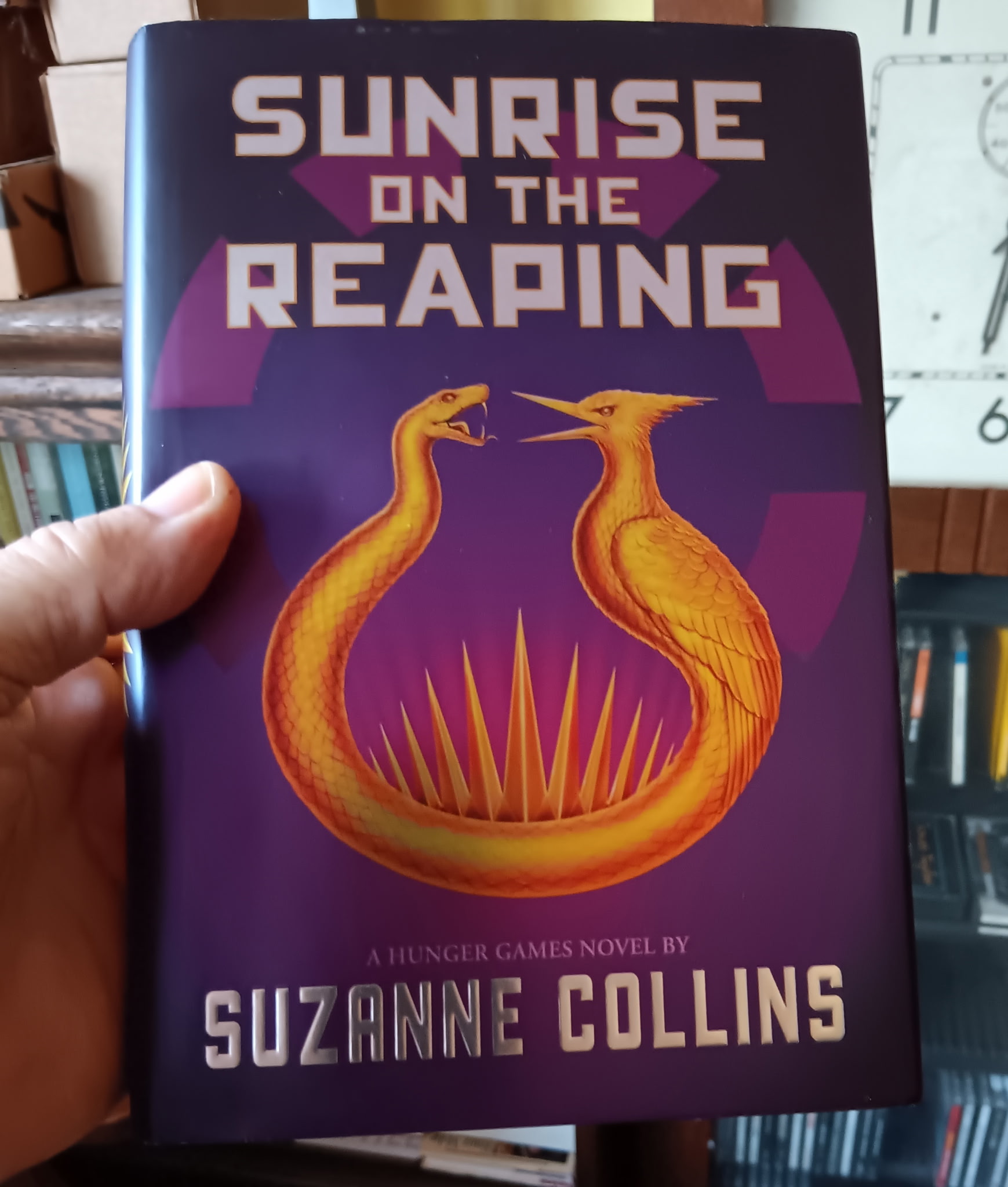
No, we read the last 200 pages of Suzanne Collins’s fifth and, in my view, best Hunger Games novel, Sunrise on the Reaping (Scholastic 2025). Actually, I did the reading, aloud. Timberley and the cats listened. Jem, our big orange tabby, might have been praying, because his eyes were closed through much of my reading. As usual, Scout kept getting into stuff, and Timberley would have to get up and reel her back in. Scout and Jem are aptly named (thanks, Linda).
Like 2020’s The Ballad of Songbirds and Snakes (Scholastic), this latest volume is a prequel to the original trilogy of Hunger Games novels. Sixteen-year-old Haymitch Abernathy tells the story of winning his dystopian society’s 50th Games. In the trilogy, the adult Haymitch acts as the coach of the competitors from his hard-scrabble home district (which, for the initial Hunger Games movie, was filmed in eastern Burke County, not that long ago the poorest metropolitan statistical area in the entire country).
More so than the other four books in the franchise, Sunrise explores the nature and power of propaganda in an authoritarian state — or, for us now, in a constitutional republic that has been dragged into fascism by an anti-democratic president, an admitted “dictator on Day One” and, as it turns out, on all days thereafter.
“I want to scream out the truth,” narrates Haymitch, as he watches the televised recap of the Games at the Victor’s Ceremony in the Capitol. “A boy’s head was blown off! People in [District] 12 were shot! My reaping [selection] was rigged! But I just sit there, mute and radiating implicit submission” (341).
Throughout the story, Haymitch considers how every word and deed might look back home in District 12, as everything to do with the Games is recorded, edited and broadcast to the 12 conquered districts as an object lesson in the futility of resisting the Capitol’s authority.
How the tributes — the competitors, four from each district — support each other in the Games and, with one exception, how they die mean more than life itself to Haymitch and his allies among the 48 doomed players. They live for each other for as long as they can or are allowed to. But even villainous tributes who are vicious killers care about how their stories are presented to the viewing public.
From the start of the book, it’s no secret that Haymitch wins these Games, but once he is the last tribute alive, he isn’t convinced he’s better off than the losers. Still, one official reassures him, “You were capable of imagining a different future. And maybe it won’t be realized today, maybe not in our lifetime. Maybe it will take generations. We’re all part of a continuum” (377).
Sunrise on the Reaping deals with the importance of controlling our narratives — or, as Haymitch and another District 12 tribute say, “making a poster” that molds public opinion and fosters support for a cause, whether good or bad. Today we call “posters” like that memes on social media. Posts from, say, the president of the United States — the most powerful man on earth, with an arsenal of nuclear weapons at his tweeting fingertips — have even more weight in the public sphere.
One other reason I like Sunrise so much is because the novel employs song lyrics and one famous poem — Edgar Allan Poe’s “The Raven” — to convey themes involving grief and our perceptions of reality. If you had trouble understanding “The Raven” in high school English class, this book’s treatment of the poem is an ingenious revelation. Novelist Collins spoons out the lengthy, repetitive poem in small enough doses to make it palatable.
I have to confess, though, that a different song lyric has been going through my head since Donald Trump was reelected and returned to the Oval Office: “the whole (wide) world is watching,” a line from Bob Dylan’s song, “When the Ship Comes In.” That lyric was a common chant during antiwar protests in the 1960s.
But you know what? Donald Trump isn’t the only person who needs to be reminded of that fact — that the whole world is watching the U.S.A. right now, as our former democracy has become a white supremacist, Christian Nationalist state run by a demented dictator and his cult of personality. No? Then who has kept Trump from doing anything, from stealing our money to going to war?
The whole world is watching … what we do … in response to all the madness.
Rise and resist. With words, courage and determination. Amen.