By RAHN ADAMS
RUTHERWOOD, N.C. (April 1, 2026) — I’m embarrassed to admit that I nodded off Monday evening during the second hour of Henry David Thoreau, the Ken Burns- and Don Henley-produced documentary about my favorite philosopher.

Then, last night during the conclusion of the long-awaited PBS presentation, I was so tired from helping wife Timberley plant four new bare-root roses yesterday afternoon that I needed to rest my eyes again midway through the hour-long show — or at least that’s what I claimed.
But Timberley is no fool — not even on April Fool’s Day — so she woke me up both evenings as soon as she saw that my eyelids were closed for more than a second. She knew how much I had been looking forward to the documentary and that I wanted to be awake for its over-the-air premiere.
I mean, it can be streamed on the PBS website, but I wanted the communal experience — if only in my mind — of watching the two-night, three-episode series when other like-minded folks across the country would be watching, too. No, it wasn’t a nationwide television event like the Super Bowl — street crime didn’t go down while the documentary was on TV — but at least the boys from New England came off looking a bit better this time. That’s a joke.
It’s a reference to Henry Thoreau and his wealthy mentor, Ralph Waldo Emerson, living most of their lives in Concord, Mass., just outside Boston, and, of course, to the New England Patriots losing this past February what I thought was the most boring Super Bowl game in the institution’s 60 years of existence. And, yes, I do remember all 60 of those Super Bowls. I didn’t rest my eyes during a single one, mainly because of all the commercials. Maybe that’s what PBS needs — more commercials. Nah. It and NPR need more fund drives.
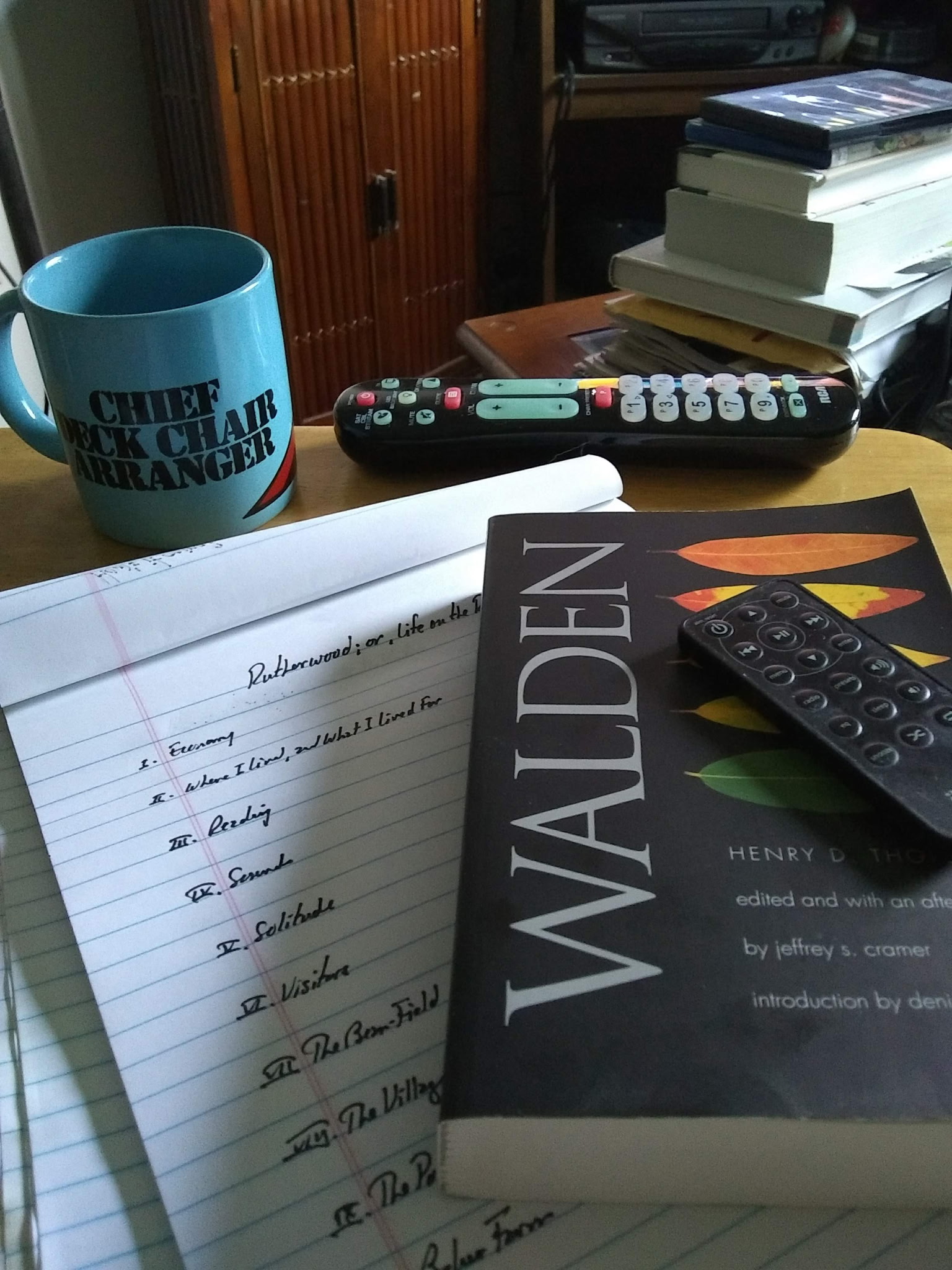
Not funny? Well, I never thought Thoreau was very funny, either, until I read more than just the long excerpts from his masterpieces, Walden; or, Life in the Woods and “Civil Disobedience,” that my teachers assigned — once in high school English, once or twice in college American lit classes. Finally, I sat down and read Walden on my own, from start to finish, and that was when I learned that Henry could be a real hoot. By the way, he would have hated everything about the Super Bowl, especially the commercials.
But the average high school student — shoot, the average college student nowadays — wouldn’t recognize Thoreau’s dry humor. Why not? Because they would have to take the time to read Walden or “Civil Disobedience” or “Walking,” my favorite essay of his, or “Autumnal Tints,” his late-life essay that becomes more and more relevant as I grow old. Additionally, a reader’s vocabulary and comprehension must be a bit higher than what the average social media meme or advertisement requires of a reader or, more accurately, viewer. Just do it. Eat mor chikin. Got milk?
I’ve got to admit, though. The Thoreau documentary was slow and plodding — kinda like me with my bad back on the Morganton Greenway these days. The show did mention that when Henry lived at Walden Pond, he regularly took his laundry home for his mother to do for him. That was one tidbit that got people’s noses out of joint back in 2015 when The New Yorker published Kathryn Schulz’s misguided hit piece, “Pond Scum.” The article made me doubt that Ms. Shulz had even read Walden. Why? Because Henry never says his intention is to cut himself off from society and live like a hermit in his little cabin sitting a mile from town.
To add some excitement, though, the filmmakers could have thrown in the fact that less than a year before Henry went to live in Walden Woods, he and a friend accidentally set fire to 300 acres of woodland near another local pond. Yeah, that’s rich — our culture’s quintessential tree hugger being called “the woods burner” by his friends and neighbors. He wrote about that embarrassing little incident in the amazing journal (pp. 21-26) that he kept throughout his adult life.
In fact, the filmmakers failed to focus on anything interesting beyond a generally dry recitation of Henry’s facts of life — nothing about that woods fire that took him three years to pay restitution for; very little about his relationship with Emerson’s wife and son while the husband and father was gone to Europe; not much about his friendships with poet Ellery Channing, his best buddy, and Bronson Alcott, and with novelists Nathaniel Hawthorne and Louisa May Alcott; and nothing at all about Henry’s “love life,” such as it was, with Ellen Sewell and Sophia Ford. Also, the documentary featured too many historians and literary scholars yakking about too much boring stuff. They should have taken Henry’s advice and simplified, simplified.
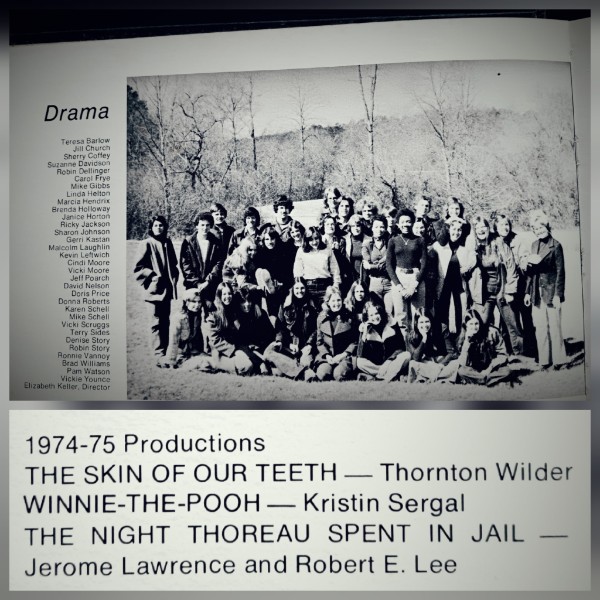
So what got me hooked on Thoreau? That’s easy to answer: a play put on during the spring of 1975 by my high school’s drama class, The Night Thoreau Spent in Jail. I was a 10th grader at Hibriten High School in Lenoir, N.C., and I had heard about Henry David Thoreau several years earlier. My older brother had come home from school one day talking about this guy his English class was studying, and how this writer had said a person needs to find a job or profession that can be their life since so much of one’s life is spent working. So I already knew a bit about Thoreau and his philosophy about one’s livelihood, at least. It made sense.
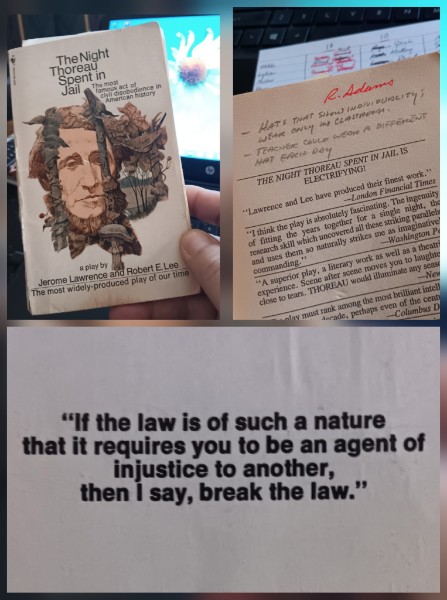
But that high school play — starring 12th grader Mike Schell as Henry — excited my interest in Thoreau, so much so that when I became a high school English teacher myself, I found a class set of The Night Thoreau Spent in Jail and read the play with almost every 10th-grade English class I taught at Watauga High School in Boone, N.C. At WHS, 10th graders then studied American literature before the 20th century, so the play’s content, at least, fit the bill. It also was a gateway text to the actual writings, making Thoreau’s dense language a bit more accessible. I did assign varying amounts of Walden and his essays to be read, but my students always responded better to the play than to Thoreau’s writings. And I think they learned more about his ideas, too.
That’s what it’s all about, right? Learning how to live more simply and happily at a time when life can be complicated and confusing. And staying awake to what’s going on around us, even when the sleepwalkers who made “woke” a bad word are trying their best to take us back to the hate-filled and disease-ridden 19th and 20th centuries in so many ways. What can we do?
Rise and resist, peaceably if possible. With words, courage and determination. Before it’s too late.