By RAHN ADAMS
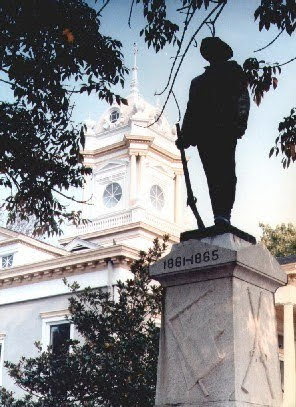
MORGANTON, N.C. (March 25, 2026) — Last week I posed several questions that I promised to answer today: Should my “Southern heritage” — or anyone’s, for that matter — be preserved as something honorable? Should Confederate monuments, like the one on the Old Courthouse Square here in Morganton, stay or be moved? And were Rebel soldiers heroes or villains, or were they both at the same time?
As it turns out, my final answers weren’t all that hard to formulate. I got a little help from my friends — from my wife and writing partner, Timberley; from a former teaching colleague who also happens to be Timberley’s distant cousin; and from another old friend who offered a practical take on that last question.
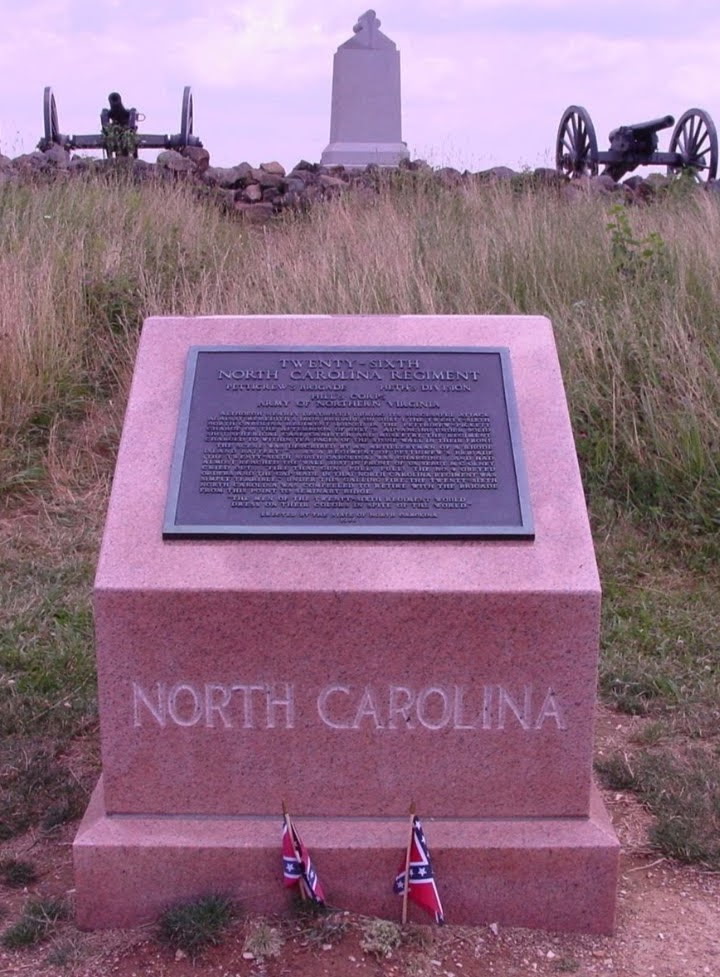
Last week I had discovered that my maternal great-great-grandfather, John W. Duckworth, served from May 1861 to the end of the Civil War as a Confederate private in Company E of the N.C. 16th Infantry Regiment. Known as the Burke Tigers, the company fought in all the major battles from 2nd Manassas (Bull Run) to the surrender at Appomattox Courthouse in April 1865. His name appears on the Morganton monument.
I did, however, also learn that John Duckworth’s Civil War record wasn’t spotless. According to the Company E roster, he “deserted on July 25, 1863. Rejoined the company on November 5, 1863, and was court-martialed.” John rejoined again a month or two later and served to the end of the war. I have no idea why he deserted three weeks after the Battle of Gettysburg; why he returned three months later; or what his court martial entailed.
Punishment for desertion ranged from being fined to facing a firing squad. Some deserters were branded with a D on their cheek or forehead, but that wouldn’t have been much of a punishment for a Duckworth, at least not by today’s tattoo-crazy standards.
My best guess is that John came back to Burke County to tend and harvest crops for his family, as Confederate soldiers were known to do during the war. Genealogical sources say he and his wife had five children under the age of 10 at home. That included my great-grandfather, Thomas Lafayette Duckworth, who was six years old at the time.
Also, the fifth child — a boy named John A. — was born during the latter half of 1863 and is listed now only as “deceased,” without death or burial records available online. Based on census data, the boy might have died during the 1870s. So maybe his birth or his mother’s condition was what prompted John W. to desert.
Records show that several soldiers in Company E deserted around that same time in the weeks immediately after Gettysburg. In fact, one other soldier from Burke County — also a farmer — deserted on the same day as John Duckworth.
According to Capt. George W. Mills’s History of the Sixteenth North Carolina Regiment in the Civil War, the outfit spent almost 10 months in late 1863 and early 1864 camped near Barnett’s Ford in Orange County, Va. They were involved in only a few minor skirmishes that late summer, fall, winter and early spring. Perhaps John decided his time could be better spent with his family and his new son and namesake back home.
All of that online research got me to wondering if there were any other skeletons in my genealogical closet, and so I went out on all four of my family tree’s main limbs — that is, I followed my Adams, Showers, Duckworth and Queen lines, the surnames of my four grandparents — as far back as I could on the Mormon Church’s free FamilySearch website, as well as with other online resources.
In brief, my ancestry is German on my father’s side; English and Scottish on my mother’s side. Nicolaus Adam (1696-1754) immigrated to America from Baden-Wurttemberg, Germany, in 1727. Christopher Schauer (1760-1836), whose parents apparently were from the same part of Germany near the Swiss border, was the first American birth recorded in my paternal grandmother’s line. The first American John Duckworth (1640-1699) — and there have been a bunch of John Duckworths kin to me through the past three centuries — arrived here from Lancashire, England, in 1684. Finally, John MacQueen (1653-1711) emigrated from Scotland’s Isle of Skye by 1690.
Yes, there were some surprises — for example, that my first American Adam(s) arrived on board the ship William and Sarah on Sept. 18, 1727, at Philadelphia, Pa., with his wife and son. All my life until now, a different Adam who got here 14 years later on a different ship has gotten that credit, wrongly it appears, thanks to a single published source.
That’s how mistakes happen, right? One writer makes the error or false assumption in his research; a hundred other writers repeat it. (By the way, that’s also why online searches using AI chatbots can be particularly untrustworthy.)
Anyway, in the course of my own perhaps faulty online research, I learned that my kinfolk fought in all the big wars on this continent, some of them on opposing sides — for the North and the South, for the Blue and the Gray — on the same Civil War battlefields. Just think, if any of those guys had been better shots or slightly slower at ducking for cover, I might not exist. Thank you, sweet baby Jesus.
I also learned that one of my grandfathers came to America as an indentured servant. Sponsored by a wealthy London merchant and slave trader — William Dockwra, the man who started the Penny Post mail service — my ancestor had to work four years for his freedom. He apparently was a carpenter. At his death, his possessions included an assortment of carpentry tools and “2 young negroe [sic] women,” according to one source. He lived in East Jersey (now New Jersey) and Maryland before his descendants moved to Virginia and finally North Carolina.
Yes, it was John Duckworth, the first one. But isn’t it fitting that my slaveholding John Duckworth from England was the great-great-great-great-grandfather of the John W. Duckworth who fought for the Confederacy? John W. didn’t own slaves, as far as I can tell. He was just a poor farmer with a wife and five kids to feed (with more young ‘uns to come after the war). But his great-great-great-great-granddaddy — an ex-slave himself — sure did own at least two.
And that brings me back to my initial questions….
We look at all issues through two lenses — a personal lens and a public lens — often relying on one more than the other, depending on the situation. Another apt metaphor is using one’s heart or one’s head to take a position on something. (Women might suggest that most men “think” with a third body part; and some husbands, in particular, with their wallets.)
As a former newspaperman, I also understand treating a controversial subject either objectively as a straight, fact-based news story or subjectively as an opinionated, feeling-based editorial or column. Both styles have pros and cons in isolation; they work best in tandem.
What I’m saying is that my ancestors who either owned slaves or fought for the Confederacy to preserve the slaveholding of others were wrong to do so and unworthy of public honor — not then, not now, not ever. So, yes, Confederate monuments in prominent public places need to go, no matter how familiar or nostalgic they are in a particular setting.
Things change, just as they did in the early 1900s when so many Confederate statues were erected across the South. They can change again. As a modern community of diverse citizens, Morganton should not define itself — with a Confederate monument at its center — as a town that once fought to preserve the institution of slavery or that supported the white supremacist Lost Cause movement during the Jim Crow era. (I could offer vivid proof from the summer of 1927 as to why the statue should go, but I’ll stop right here for now.)
But were there any heroes fighting for the Confederate cause? For example, was John W. Duckworth heroic in any sense? To his brothers in arms on the many battlefields they saw — at Bull Run, Antietam, Fredericksburg, Chancellorsville, Gettysburg, the Wilderness, Cold Harbor, Petersburg and Hatcher’s Run, to name the bloodiest ones? Was John a hero to the other Burke County farmer who deserted with him and later returned as well? Did John’s wife and children here in Burke County understand his absence from them and appreciate his desertion from duty to come home however briefly?
Or was John W. merely a rebel, a deserter, a traitor to the U.S.A. and one who helped perpetrate the myth of the Lost Cause, the belief that the South’s white supremacy would rise again, which, of course, it has over and over and over to this very day in which we live?
As I’m sure you’ve already guessed, I see my great-great-grandfather in both lights — as a private hero to his family then and now, but as a flawed individual who fought the wrong public battles for whatever his practical (or impractical) reasons might have been. I wish there were letters or a diary so that he might explain himself, as is the case with the aforementioned Capt. George Mills of Rutherfordton and some other old soldiers.
They never die, you know. They simply fade away. But their causes never do.
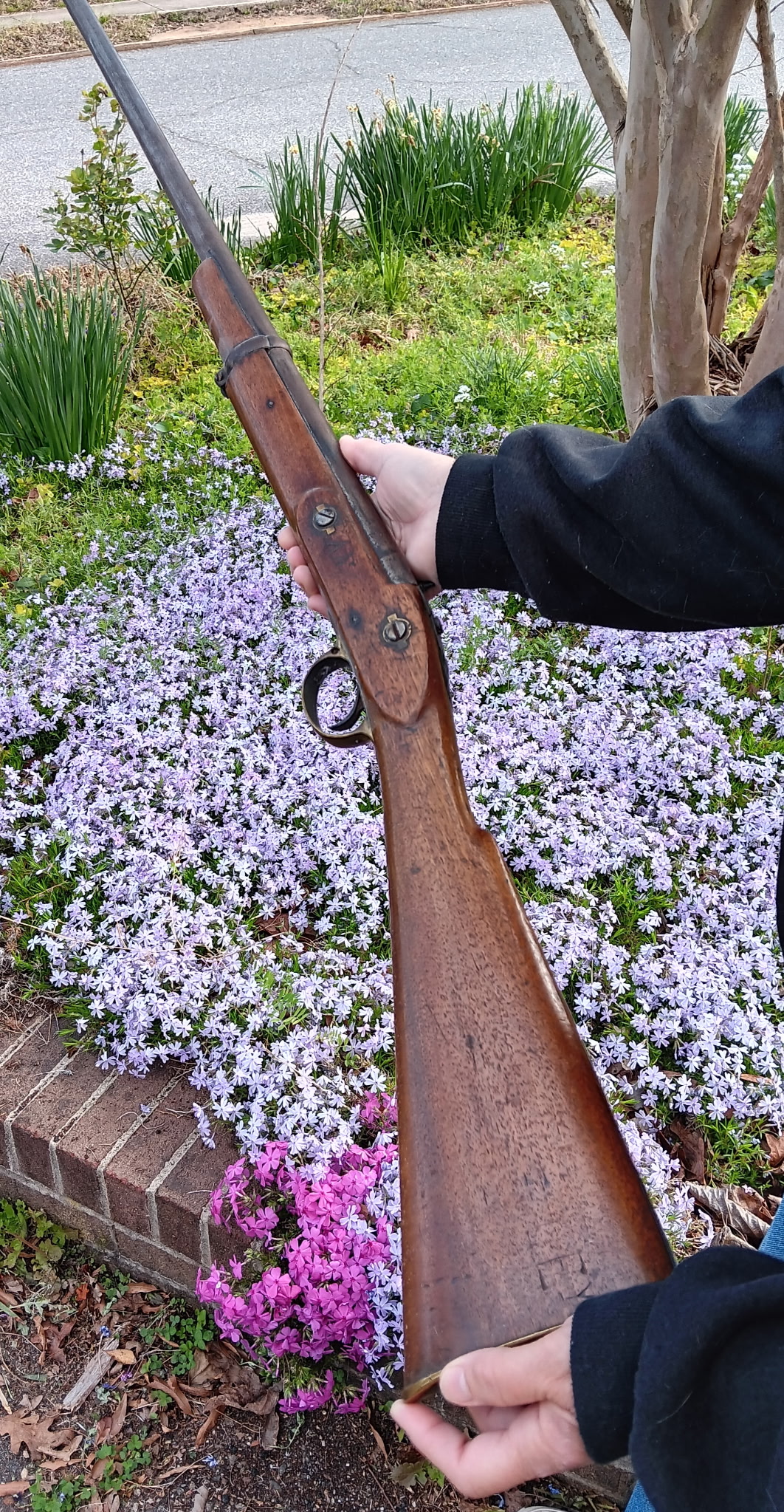
We went to the Civil War Museum in Harrisburg, PA, and saw an 1853 Enfield rifle like this one, but it had wood going all the way up the barrel. The display said many rifles were found like this with some barrels bent and the wood broken off where the soldiers resorted to using them as clubs. I should add that it is definitely heavy enough to pack a serious wallop.