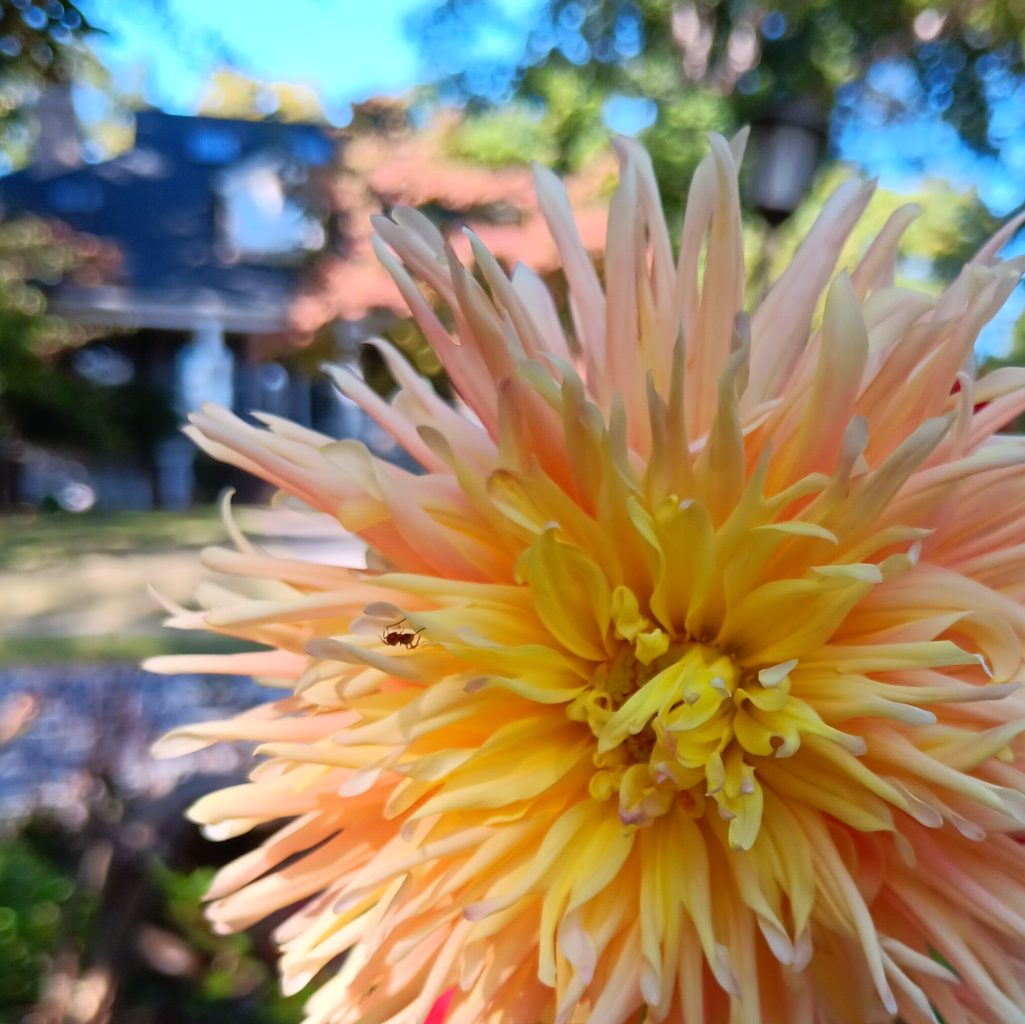
THIS BEAN PLANT doesn’t seem to be suffering too much because it has had to spend all winter and so far this spring indoors at our house. It will be back outside soon enough.
By RAHN ADAMS
BOONE, N.C. (March 15, 2020) – With this essay, I’m traveling backwards in time, as I return to August 2019 when I was working on this book’s “Bean” chapter. Remember last August? That seems like years ago, not seven months ago. And we will be traveling back to the future with my next installment.
Last August, I was just turning 60, so I wasn’t quite “elderly” yet, as health officials say I am now with the current concern over the coronavirus pandemic. Timberley and I went out to eat downtown several times to celebrate my birthday month, at Root & Vine, our “special occasion” restaurant in Morganton, and at Kin2Kin, our local “go-to” restaurant, where I lucked up and got two fortune cookies in the same package. Also, I finished planning this project, and I wrote its first two chapters, each with three parts.
FORSYTHIA BUSHES BLOOMING now are also called yellow bells or golden bells for obvious reasons. This healthy forsythia reaches for the sunny sky from my mother-in-law’s yard near Morganton.
By RAHN ADAMS
MORGANTON, N.C. (March 12, 2020) – I’m writing this installment on my phone as I wait for Timberley at the Burke Literacy Council this morning, so if it seems more disjointed than usual, that might be why. But maybe this half-fast, thumb-driven essay will be everything you’ve always wanted in my fare, and less! More taste, less filling? I hope not—the latter part, anyway.
I used a Miller Lite allusion there because I read an article online this morning about golfer Rory McIlroy saying that playing a golf course designed by Pete Dye is an acquired taste, like being turned off by one’s first-ever sip of beer before learning to tolerate it and then finally liking it maybe too much. A lot of things are like that—acquired tastes … and bad stuff we like too much.
Sometimes I think golf itself—not just a Pete Dye course—is one of those bad things. I never played the Pete Dye course at St. James Plantation near Southport when we lived in Brunswick County, but I’ve been watching too much televised golf on Saturday and Sunday afternoons for the past few weeks, and the Masters is still a month off. I’m itching to hit the driving range, even though I can’t roll over in bed or hop into the driver’s seat of our van without hurting my back.
But I can’t help myself. I want to cast off the winter blues and revel in the green of springtime by smacking a bucket of little white balls across an open field. I’m tired of being cooped up indoors. I want to go outside and soak up some sunshine, work up a good sweat, maybe even rub a little blister on the fleshy part of my ungloved index finger. Sunburn, sweat and blisters. Spring can’t come a moment too soon.
IN OUR BACK YARD this Japanese dogwood once struggled to live, but it survived and is covered with white blossoms in the summer.
By RAHN ADAMS
MORGANTON, N.C. (March 8, 2020) – I’ve mentioned before that we’ve lost several dogwood trees over the past few years in our front yard here—two white ones along the street that we replaced with a single crapemyrtle and a pink one on the side that Timberley’s dad had strangled with Christmas lights, as if he had been trying to stunt its growth the way a bonsai artist would wrap a tree with copper wire.
Nat, my father-in-law, liked blue twinkle lights for some reason and had wound at least a dozen strands of them around the trunk and every sizable branch of that pink dogwood. That was 25 Christmases ago when the tree still had some growing to do. We inherited the tree about 12 years ago and over the next five years or so watched it lose one diseased branch after another until we finally had Grady Rose, the best arborist in Burke County, take down the whole tree and a similarly ailing white dogwood out front.
The other white dogwood had already been destroyed in an act of God—a thunderstorm that lashed our side of town with heavy rain and high winds. That was in the old days when my back was still OK, and I could wield a chainsaw like a lumberjack all day. We cut up the dogwood and left it for the city brush truck to haul off. Before disposing of the tree, we did manage to save the string of solar-powered lights like Chinese lanterns that Timberley had hung in the low limbs. Yes, I know. Like father, like daughter.
OUR PINK DOGWOOD is still a few weeks from blooming, but memories of last year’s blossoms are crosses worth bearing.
By RAHN ADAMS
MORGANTON, N.C. (March 1, 2020) – Like the dogwood’s beauty, religion should be simple—and it is when one’s path on this challenging course called life is true. Not necessarily smooth. Or straight. Or wide. But true, as in the right path that leads the traveler to a meaningful coexistence in this wild world.
Today is the first Sunday of Lent, so I’m going to use the break (Sundays aren’t counted in the 40 days of Lent, the period of reflection leading to Easter) to think about religion in general and Christianity in particular. We’re currently “taking a break” from church—giving it up for Lent, I guess, maybe longer.
Two months ago, the church we had attended for years changed its main worship service to a time that was too early for us to attend. We were going to attend a later Sunday morning service until the pastor announced that he wouldn’t be preaching at that gathering, just at the earlier, more contemporary service.
Alrighty, then. But I’m getting off track here, off the right path. Maybe staying on course isn’t easy after all.
OUR PINK DOGWOOD out front in Morganton was as beautiful as ever last April. It’s one of only two dogwoods that we have left after losing several trees to disease and storms in recent years.
By RAHN ADAMS
BOONE, N.C. (Feb. 26, 2020) – It has always seemed odd to me that the dogwood—a small tree found from the mountains to the sea—is North Carolina’s state flower, while the longleaf pine, found only in eastern N.C., is our state tree. Our legislature, in its infinite wisdom, made those decisions in 1941 and 1963, respectively. I would have picked an entirely different state tree or at least a more common pine.
Maybe the scrub pine, Pinus virginiana, or loblolly pine, Pinus taeda, would be more appropriate now, as both are much more numerous in wider regions than the majestic longleaf variety, Pinus palustris, of our coastal plain. Wikipedia says that the longleaf pine is a “cultural symbol” of the South as sources of resin (pine tar), turpentine and timber needed by 18th– and 19th-century merchants and ship builders—yeah, back when we were true Tar Heels, before the One-and-Done Era of college basketball.
THE CAMELLIA OUTSIDE my parents’ dinette window blooms like this every winter. I remember Mom standing at the window and enjoying the now 50-year-old bush’s blossoms.
By RAHN ADAMS
BOONE, N.C. (Feb. 20, 2020) – We really wanted to attend this weekend’s Tidewater Camellia Club annual show in Wilmington—and, well, to eat breakfast one morning with my buddy John at Inlet View Bar & Grill at Shallotte Point. We’ve wanted to do that for a while, but our plans never work out.
Almost 30 years ago, I worked for John at a medical office management company in Shallotte while I was attending the University of North Carolina at Wilmington. He was one of the best supervisors I’ve ever had, only partly because he was a kindred spirit—a former high school teacher and coach, and an Atlanta Braves fan. At the time, I was learning to be a teacher and coach, so he was a valuable mentor. Together we also suffered through the Braves’ World Series losses to the Twins in ’91 and the Bluejays in ’92. John gave me a red foam tomahawk from one game. I gave him my Chipper Jones rookie card.
His wife Amy, also a teacher, showed Timberley how to fix a low-country boil, with potatoes, ears of corn, sweet onions, smoked sausage, chicken breasts, shrimp and clams. We’d gotten together at John and Amy’s home on the intracoastal waterway for the opening game of the ’91 World Series, one of the best fall classics ever. The food and the fellowship were great. The game—a Twins win—not so much.
This past Saturday night, Timberley made a low-country boil just for the two of us. It was good, but it got us thinking about the possibility of a quick trip to the coast. Inlet View had reopened for the season on Valentine’s Eve and was even serving breakfast again on Saturday and Sunday mornings. John takes spectacular sunrise photos every day from one of Inlet View’s decks and posts them on Facebook. For weeks I’d followed and liked those glorious sunrises, along with John’s countdown to Reopening Day.
MY FAVORITE CAMELLIA BUSH is one whose pink blooms I’ve enjoyed every winter since boyhood. For the past week, it has been covered with blossoms and buds that should be blooming well into March.
By RAHN ADAMS
BOONE, N.C. (Feb. 10, 2020) – I’m afraid that our camellia is cursed, and I’m not sure I should forgive Lowe’s Garden Center for selling it to us. After last week’s mild weather, I just knew that one huge bud, the only big one on our spindly little Kanjiro, for which we had paid $10.98 plus tax three months ago, would be open in all its roseate glory when we got off the mountain. But no. That bud was a dud.
The information card that came with our camellia—and is still attached to it—says it needs three to six hours of morning sun and moist soil its first year to bloom in the fall and winter of Planting Zone 7. We—or, rather, Timberley—had followed all the planting instructions, and I’d checked on its progress each weekend so that I could record that first beautiful pink blossom on our camellia, not on someone else’s.
LAST SUNDAY MORNING, only one blossom on our neighbor’s large camellia bush shone in the sun.
By RAHN ADAMS
BOONE, N.C. (Feb. 5, 2020) – Five years ago when Appalachian State University won its first Camellia Bowl—it won two in a row—life in Boone changed for good. That was the start of a run that hasn’t ended yet, with our Mountaineers having won five straight post-season bowls since moving up to college football’s top division. They’ve also won the Dollar General Bowl and two New Orleans Bowls.
What difference do bowl wins make? Well, when App State football is at home on Saturdays in the late summer and early autumn—and on the occasional Thursday night—the place to be is Kidd Brewer Stadium, or in the vicinity, at least. The sights, sounds and smells of tailgating fill the senses and the air on Rivers Street and Stadium Drive, even off campus on Howard and King streets downtown.
Everyone who is someone in Boone is tailgating somewhere close to campus sometime before the big football game. Those of us who aren’t anyone, really, stay home and watch on TV or listen on the radio.
OUR NEIGHBOR’S CAMELLIA is covered with buds, while the small camellia we planted two months ago is still trying to take root. But the bush next door is huge and has been there a long, long time.
By RAHN ADAMS
MORGANTON, N.C. (Jan. 30, 2020) – Poet Nikki Giovanni’s joints are like camellia buds in January—tough, resistant to coldness, blunt … but when her words blossom … worth the wait. Inside those tightly wrapped layers of pink, brown and white, her poems are as soft, as warm, as right as our hearing allows.
For the second time in our lives three Mondays ago, Timberley and I heard Miss Giovanni speak, both of her appearances at Appalachian State University in Boone. The first time was in 1995 at a children’s literature institute that also included children’s authors Brock Cole and Gloria Houston. I don’t especially like that label—children’s author—because it implies, to me, anyway, that the stories and poems aren’t also good for adult consumption. Often I’m nourished so much more fully by children’s literature than adult.
OUR CAMELLIA HAS BUDS but is taking its own good time blooming this winter. I had trouble photographing the stubborn little buds until I finally thought to put something solid — my hand — behind them.
By RAHN ADAMS
BOONE, N.C. (Jan. 21, 2020) – The camellia that Timberley planted in our Morganton yard looked like it might bloom soon when we bought it a couple of months ago. We’ve been checking the small plant’s buds religiously, but they don’t seem to be doing anythingat all, neither shriveling up nor bursting into a leaf or blossom to adorn one of the world’s most beautiful and fruitful evergreen shrubs.
Indeed, the information card still attached to the plant we bought at Lowe’s Garden Center says that our Camellia sasanqua (C. hiemalis ‘Kanjiro’) is hardy in Zone 7, including Morganton, though not in Zone 6, including Boone. The card also asserts that the plant’s Pepto-pink blossoms appear in fall and winter.
So that’s why we haven’t planted a camellia of any type—and there are a few hundred species—here at the Rutherwood house. That doesn’t count the veritable thousands of hybrids grown by camellia lovers and shown in the late fall, winter and early spring at camellia shows across the country in Zones 7-10. None of them could live through the winter here in Rutherwood, where for the past couple of nights, for example, the temperature dropped to 12 degrees—which old-timers consider to be almost balmy, by the way.