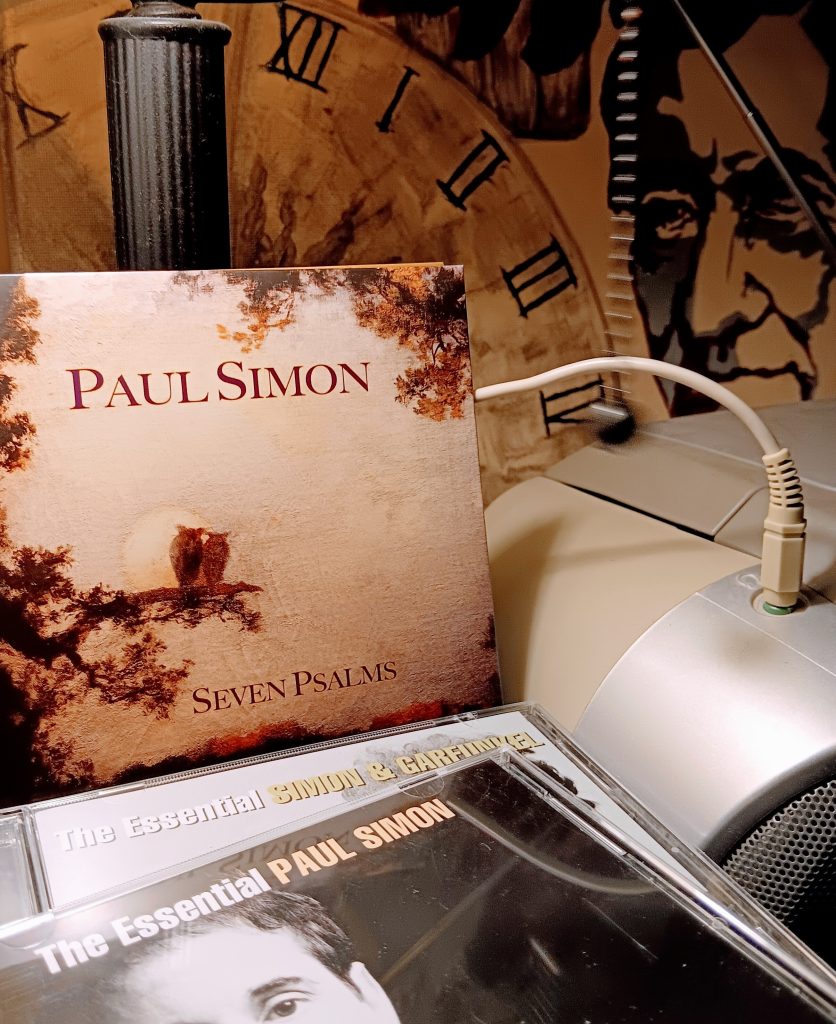
EVENSONG 138

The telling verse is this sniveling psalm is the sixth one: “Though the Lord is on high, / Yet He regards the lowly; / But the proud He knows from afar.”

Does that sound like any reality you know? I’m not referring to plans; I’m referring to practices. Are the lowly well regarded? And are the proud put off?

You may say, no, but that isn’t God’s plan. And my response would be, well, if you’re waiting for Him to act, you’d best put the plan into practice yourself.

EVENSONG 137

The great F. Scott Fitzgerald must have visited this psalm — “By the rivers of Babylon” — once or twice. It’s about being a poor artist among the beautiful and damned on this side of paradise.

Like the psalmist, Scott knew how it felt to dance around the rich and powerful crowd of his day. He used his talent to make himself part of the Lost Generation, like Zelda, Gertrude and Ernest.

But unlike the Ancient Hebrew psalmist, who would not play and sing for his Babylonian captors, Scott churned out the words and “razed” not Babylon around him, but instead destroyed himself.

EVENSONG 136

Here’s another copycat psalm, this one repeating whole lines from yesterday’s song. The big difference is that it’s a call and response, with a line that loses its meaning through repetition.

This psalm recounts YHWH’s triumphs on behalf of His people: Creation, the Exodus, military victories over Pharaoh of Egypt, King Sihon of the Amorites and King Og of Bashan (no joke).

And then there’s the line about YHWH that’s repeated over and over and over again: “For His mercy endures forever.” But what does that line mean? Would Pharaoh, Sihon and Og agree?

What, then, is mercy “[t]o Him who made great lights … [t]he sun to rule by day … [t]he moon and stars to rule by night”? After all, day and night are relative depending on where you stand.

Repeatedly, David’s psalms have shown that YAH was merciful only to David himself, mooning over the liar, rapist, murderer and king when He should have been more like the merciless sun.

EVENSONG 135

This first psalm after the 15 “Songs of Ascents” is a greatest hits compilation — a mashup of popular riffs from David’s first 119 psalms.

There’s “the Lord has chosen … Israel for His special treasure,” and “Whatever the Lord pleases He does, / In heaven and in earth.”

Also, “He defeated many nations / And slew mighty kings,” and “The idols of the nations are silver and gold, / The work of men’s hands.”

That’s all well and good, but you’ve got to admit that every other “nation” feels the same way, and that’s why everyone is always at odds.

Give me a creator who truly loves his entire creation in all its flawed perfection; and give me a god — a universal spirit — of laws and order.

EVENSONG 134

This is the last “Song of Ascent” — sadly, because all 15 are brief. Just three short verses in this one, addressed to “[a]ll you servants of the Lord, / Who by night stand in the house of the Lord!”

These “servants” must be like the few dependable church-goers I remember from my childhood who would always attend Sunday night Bible studies and Wednesday evening prayer meetings.

“Lift up your hands in the sanctuary, / And bless the Lord,” says the psalmist. Or maybe they’re more like a charismatic crowd of faith healers, rattlesnake handlers, foot washers or holy rollers.

I really do hate to see the end of these special songs that were sung by the Ancient Hebrews as they ascended the Judean hills toward Jerusalem. Now I can’t wait for King David to take a hike.

EVENSONG 133

In this penultimate “Song of Ascent,” the psalmist exclaims “how good and how pleasant it is / For brethren to dwell together in unity!”

That’s a funny exclamation for this Super Tuesday, when the best President we’ve had in ages continues to be maligned by the worst.

Then two images: oil on a holy man’s head, like a Gatorade bath for the winning coach; and dew “descending upon the mountains of Zion.”

The psalmist’s conclusion — “Life forevermore” — contradicts the Israelites’ view of death. After all, every winning streak comes to an end.

EVENSONG 132

This “Song of Ascent” deals with David’s pledge to build a temple to YHWH in Jerusalem, a promise unkept until son Solomon’s rule.

David is quoted as telling YAH he would not sleep until the temple was built as “Your resting place, / You and the ark of Your strength.”

Obviously an exaggeration, David doesn’t explain that when he went “to the comfort of [his] bed,” he wasn’t there to snooze, anyway.

Just ask Bathsheba, with whom David made whoopee and then had her old man killed. The king wasn’t thinking about sleep that day.

In turn, YHWH promised to prop up sinful King David and to ensure that “the fruit of [his] body … shall sit upon [his] throne forevermore.”

What really mystifies me, though, is how the Ark of the Covenant, which contained the laws of Israel, is presented as “[YAH’s] strength.”

How can something be a strength — like the Ten Commandments or like, say, our Constitution — if a weak man is greater than the law?

EVENSONG 131

I ain’t too big for my britches, and I ain’t got no big goals. I don’t worry myself with big doings or with high and mighty stuff that’s over my head.

I’m cool as a cucumber and quiet as a church mouse. I’m like a babe that don’t need to suck on a milk bottle no more. If I’m a-lying, I’m a-dying.

EVENSONG 130

This psalm sounds more like an actual song than all the others I’ve read so far. The lines pop and are pithy, poetic and repetitive.

“I wait for the Lord,” the psalmist writes, “my soul waits, / And in His word I do hope.” I bet my bottom dollar that line’s in a hymnal.

But what do those lyrics mean? Why is the psalmist waiting for his lord? And what soul-stirring action is this lord expected to take?

In response, allow me to parse verse 3: If bad behavior — however it’s defined — were always punished, no one would be spared.

Then, verse 4: But — as we all know — innocent people are often punished, and “sinners” are often rewarded for their worst “sins.”

So, the way I see it, this poor psalmist is like us all — saints and sinners alike. He’s waiting for the fickle finger of fate to fall on him.

EVENSONG 129

This “Psalm of Ascent” is another one about enemies who “have afflicted me from my youth; / Yet they have not prevailed against me.”

From there on, though, the psalmist uses agricultural images — withered grass, empty-handed reapers and inactive binders of sheaves.

My favorite metaphor is, “The plowers plowed on my back; / They made their furrows long.” But YHWH rescued him and cut those cords.